Street Games: Are You Playing Out After Tea?

Updated: Aug 9, 2025
In the days before we were inclined for various reasons to stay indoors, the opposite was true. Whether it was your mum wanting to get some peace and quiet, a Red Hand Gang plot to re-enact, or simply the spirit of pure adventure, kids of the 1970s and 80s spent a lot of time outdoors, with mealtimes or the activation of the sodium street lamps signalling home time.
Depending on where you were brought up, there were various street games that would while away the hours in-between your favourite television programmes, and whereas virtual reality, social media and computer gaming may be all the rage in the present era, engaging with actual physical reality leaves such tech trailing in the dust and gravel. Once you’d picked that gravel out of your kneecap one tiny stone at a time after attempting to skid your bike through a full 360°, other, less-boisterous forms of entertainment were necessary to help the Witch Hazel "take down the swelling", and “bring out the bruising.”
The first game of note was called Kerby. In the 70s and 80s there were far fewer cars on the road than there are today and plenty of kerb space. There was also a lot more dog muck to watch out for, and some of it was the mythical and infamous white, powdery dog muck. Part of the reason for this was because there used to be a lot of stray dogs roaming the streets. Every road seemed to have its very own mascot stray dog. As for the white muck (which I accidentally picked up on more than one occasion) well, 80's folklore had me convinced for a while that it was a specific type of muck produced only by poodles. There was a Polish lady who lived in our road who had two such dogs, but based on their size and the shear amount of the stuff I encountered, I was never fully convinced by the poodle argument. Apparently, the truth behind it was that dogs' diets at the time contained far more bone courtesy of the local butcher, and it was the high calcium content which was responsible. If there are any vets or dog dieticians out there, feel free to correct me because it’s been bugging me for years along with the other big-hitters like quantum physics and the freaky witch out of Chorlton and the Wheelies.
Anyway. Kerby.
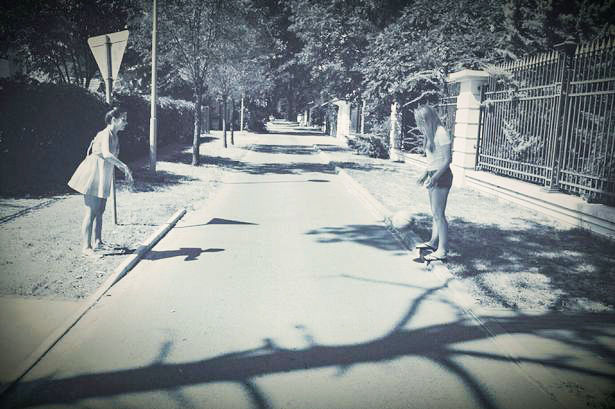
Essentially, the game involved two people and a ball. The aim was for each person to stand on a pavement opposite one another and throw the ball at the opponent’s kerb. There was a simple scoring system:
0 Points
The thrower doesn’t hit their opponent’s curb with the ball.
The thrower hits the curb, but the ball doesn’t return to their side of the street.
The thrower doesn’t hit their opponent’s curb and the opponent catches the ball.
1 Point
The thrower hits their opponent’s curb and the ball rolls or bounces back to their side of the street, or the ball returns through the air but is not caught.
2 Points
The thrower hits their opponent’s curb and the ball returns through the air and is caught.
In the version we played, there was also a possible 3-point score. This was achieved if a car happened to be passing by at the time the ball was thrown. If the ball cleared the car and hit the opponent’s kerb, then this would result in 3 points.
Kerby was regularly brought to a temporary pause if a car clearance was attempted, but the thrower was a bit of a duffer and the ball hit the roof of the vehicle. Not a lot of cars had decent breaks back then, which was a bit of a blessing because it gave you a couple more seconds head-start escaping the wrath of the driver. However, if you were wearing a pair of those mysterious 1980’s black pumps (Plimsolls) that could make you run faster, then you didn’t even need the head-start.

The next street game, which was a forerunner to what would become known as "anxiety", was, Kick the Can. The cruel twist on Hide and Seek involved a nominated seeker whose job it was to locate the hidden members of their gang. At the start of the game, carefully-defined boundaries were set such as a house half way down the street or the enclosure of a cul-de-sac, before an empty drink can was placed in the middle of the road. Once ready, a member of the group would kick the can as far down the road as they could whilst the seeker closed their eyes and counted to 30. Whilst their eyes were closed, the rest of the gang would find suitable hiding places within the defined boundaries.
When the seeker opened their eyes, they’d reposition the can in its original position (even if it was severely damaged) and then proceed to locate each member of the gang. To capture someone, the seeker had to physically touch them. However, if during their search another member of the group sneaked out of their hiding place and kicked the can, then the seeker had to return to the starting location, reposition the can and count to 30 again before repeating the process. As seeker, you would often find yourself on the verge of discovering someone hiding thanks to a rustle in a bush, only for your hopes to be dashed by the sound of a can clattering in the distance. If the seeker was significantly younger than the hiders, then the sound of a clattering drink can for the fifth time would often bring them to tears.

The final street game (if you can call it a game) might have been unique to where I was brought up. It was called, ‘Knacker Raid ', although I’m not sure if I have the spelling correct.
In the early 1980s, there was a lot of urban redevelopment taking place across the UK which meant that there were lots of demolition and building sites to explore. The premise of a knacker raid was simple. You had 30-minutes or so to construct a barrier or a base of some description amongst the rubble of a demolition site, and to collect as many stones and small rocks as you could. Your opponent would do the same at a distance of about 50-metres or so from yours. Once the defences were in place, all that was left to do was to spend the next hour or so launching stones at the opponent’s base or directly at the opponent themselves. It was all perfectly agreeable until the stones became quarter or half bricks. I suspect the name 'knacker raid' stems from where you might end up if you didn’t keep your wits about you. In the Knacker’s Yard. It's little wonder that kids in the 70s and 80s would have double-figure cuts and bruises on their legs at any given moment.
As primitive as it was, I can't think of an activity that developed the motor skills and exercised the mind and body more effectively than a knacker raid. Unlike a video game, the risk of physical injury (at the hospitalisation level) was real, and the smell of Tarmac and rubble put incense sticks and air fresheners to shame.
What outdoor games do you remember playing and were you any good at them?
Comments